
Table of Contents
Key takeaways
- AI agents are strong at investigating variances and drafting commentary, but the forecast and the decision are where most of the risk lives
- Every step in a finance workflow has one owner: code does the math, AI investigates and drafts, people make the call
- Place any task with three questions: magnitude, frequency and recoverability
- A human approval gate only works if the reviewer can see the evidence and their decision flows through to the real forecast
- Start with one lane, run it for two closes, and track time saved and corrections


This is a guest article authored by Glenn Hopper, Founder of RoboCFO. He'll be hosting an AI masterclass on agents in finance workflows with Pigment's Head of Applied AI Tim Brennan - sign up here!
Every finance team knows the week after close: Revenue came in under plan, margin moved, and now some one in leadership wants three answers, and there goes your weekend. They want to know what happened, what it means for the forecast, and what to do about it.
Agents are already good at that first question. Point one at the ledger and the operating data and it will find the drivers and draft variance commentary before your coffee gets cold. The second and third questions are where finance teams are still deciding how much to hand over,and where most of the risk lives. (For a snapshot of where finance teams stand on AI today, see 10 statistics FP&A leaders should know).
I've spent most of this year building agents for finance teams, and the question I hear most is around ownership. When finance hands work to an agent, who does each part?
Finance needs the same answer every time
A language model's draft is fluent, confident and plausible … which is exactly what makes it dangerous when it's wrong. Finance runs on the same inputs producing the same answer, every single time. Auditors, lenders and boards depend on it. Language models work the other way - ask the same question twice and you can get two different answers. That flexibility is what lets a model read a supplier contract, connect a freight invoice to a margin miss and explain it in plain English.
It's also why "let the AI do the forecast" makes a controller nervous.
What makes something an agent
"Agent" is getting bandied about the way "big data" was ten years ago, so let's pin it down. An agent has four parts:
- A goal, with a test for done, so it knows when to stop.
- Tools, the functions it can call to query data, run a calculation or write a file.
- Memory, what it has learned during the run and what it carries forward.
- A loop: plan, act, check the result against the goal, and go again if it isn't done.
The loop is what makes it an agent. Here is how it compares with the tools you already know:
If you've ever watched a sharp senior analyst chase a variance (pull the detail, notice something odd with one supplier, go read the contract), you've seen the loop. That freedom is what makes agents useful in messy finance work.
What is an agent harness?
So the governing has to happen around the model. That system is the harness: the orchestration that sets the sequence, the tools the agent is allowed to touch, the guardrails and approval gates where it has to stop and ask, and the evidence trail that records every call, check and decision. Think of it as your close checklist and review sign-offs, written down in a form a machine has to follow.
Who owns each step in a finance workflow: code, AI or people?
Inside the harness, every step in a finance workflow has one of three owners.
- Code does the math, the rules and the checks: variance calculations, the forecast roll-forward, scenario runs, tying out every number
- AI investigates, explains and drafts: finding the drivers, writing the commentary, proposing responses, drafting the memo
- A person makes the judgment calls and signs off. Is this one-time or run-rate? Which response do we choose? What goes to the board?
Code does the math, AI drafts, people make the call. Keep the model away from arithmetic, and keep your analysts away from busywork.
How do you decide which finance tasks to hand to an agent?
Take any task on your close checklist and ask three questions.
- Magnitude: how big is the number at stake?
- Frequency: how often does the task run?
- Recoverability: how easily is an error caught and reversed?
Most of the value today sits in the middle (variance commentary, forecast updates, scenario builds), where the agent drafts and a person reviews.
One variance, followed all the way through
For the masterclass, I built a demo around a fictional company, Corvane Climate Group, with synthetic data. The scenario is: a month just closed, revenue is under plan, and margin has moved.
Code computes the variances. The agent investigates the drivers and drafts the commentary, citing its evidence. Then code checks every number in the draft against the source data. In the demo, I planted a figure that doesn't tie, and the validator catches it and sends the draft back. Models are very good at explaining numbers and unreliable at producing them, so in this harness the model's arithmetic never reaches a reviewer unchecked.
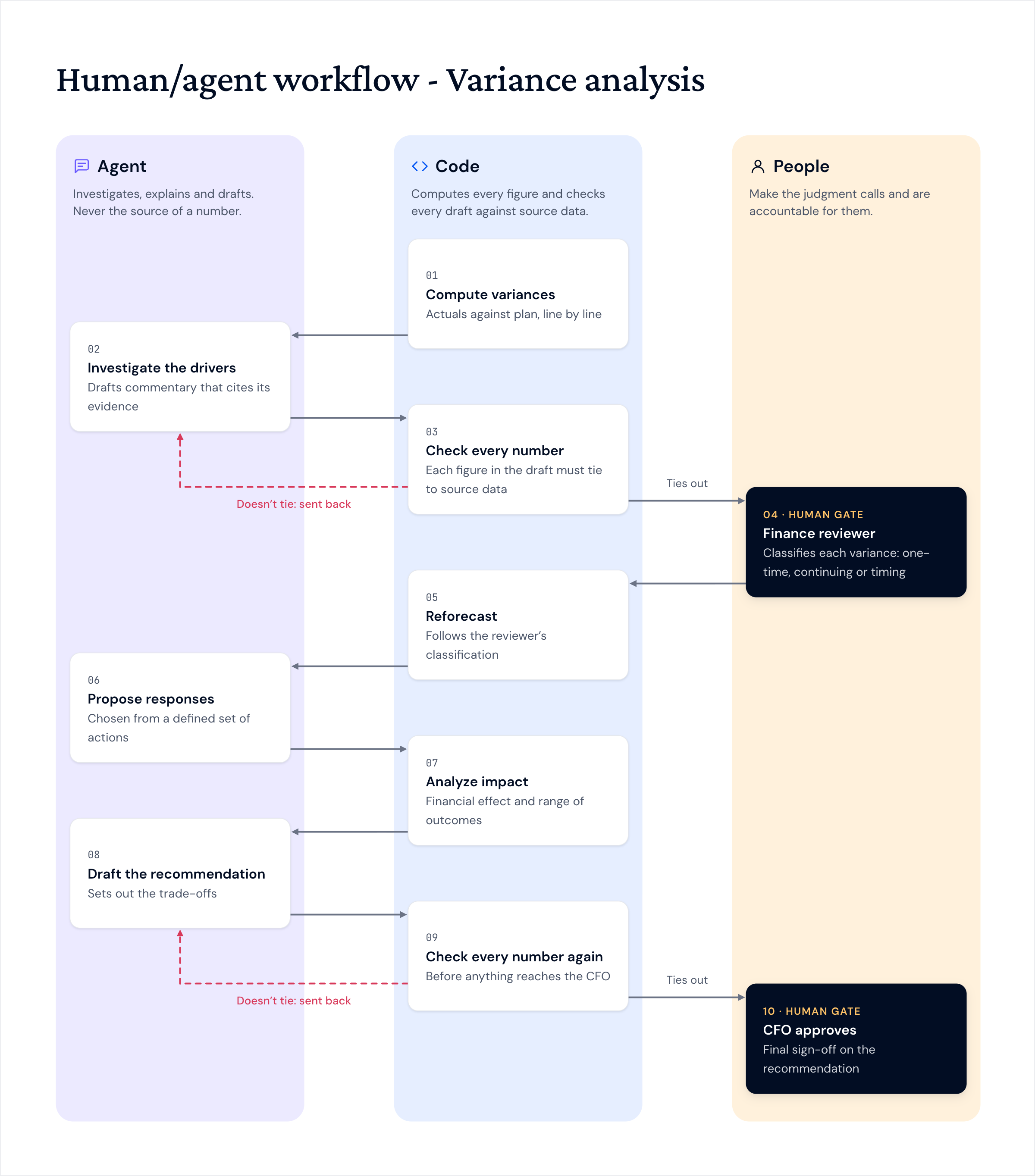
Then comes the first human gate. A finance reviewer classifies each variance as one-time, continuing or a timing difference. Take a material surcharge from a supplier:call it one-time and the forecast barely moves. Call it run-rate and code carries it through every remaining month of the year, and the outlook looks very different. The agent can lay out the evidence for either reading. The classification is a judgment someone is accountable for, and the reforecast follows that person's call.
From there, the agent proposes responses from a defined set of actions, and code calculates the financial effect and the range of outcomes for each. The agent drafts the recommendation and the trade-offs, code validates it again, and the CFO makes the final approval. Out the other end comes a management memo with forecast and scenario exhibits, plus an evidence trail of every tool call, model call, check and decision, with who made each one.
What should a reviewer see at a human approval gate?
A human gate is only as good as what the reviewer can see when they get there. If they have to redo the analysis to trust it, the agent saved nothing. If they can't see where a number came from, the approval is a rubber stamp. (If you've ever signed off on a reconciliation late on day three of close, you know how that happens).
In the demo, each line of commentary carries its evidence: the source records the agent pulled, the calculation code ran and the validator's result. Before clicking anything, the reviewer sees the drivers, the proposed classification and what each choice does to the forecast. The reviewer's time goes to the judgment, which is the one part we actually need a person for.
Where does planning come in?
The back half of that workflow (reforecast, scenarios, decision) is planning work, and it needs a governed model of the business behind it: agreed drivers, versioned assumptions and clear rules on who can change what. Hand an agent a spreadsheet copy of the forecast and you'll get exactly the kind of untraceable plug finance has spent twenty years trying to get rid of.
Platforms like Pigment put the agents inside the planning model itself. Pigment's Analyst Agent investigates performance and drills into root causes, and its Modeler Agent builds and adapts planning models from a plain-language description, with every action explainable and traceable. When the agent works in the same model the finance team already owns, the reviewer's run-rate call updates the real forecast, the scenarios run on the real drivers, and the decision sits next to the numbers it changed.
What should you ask before trusting an AI agent with your forecast?
Whether you build agents yourself or use them inside a platform, ask to see three things before you trust one with your forecast.
- Show me a validator catch. Plant a number that doesn't tie and see whether the system stops it before a person reads the draft.
- Show me a human decision changing the math. If the reviewer's call doesn't flow through to the forecast, the gate is decoration.
- Show me the evidence trail. Every tool call, model call, check and decision, with who made it. It's the first thing your auditors will ask for, and your board won't be far behind.
Which other finance workflows follow the same harness?
The pattern carries well beyond variance analysis.
- 13-week cash forecast: code rolls the weeks forward, AI explains the cash movement, a person makes the funding call.
- Reconciliations: code matches the transactions, AI researches the breaks, a person clears exceptions over threshold.
- Board reporting: code ties every figure, AI drafts the narrative, a person gives the final read.
How should a finance team start with AI agents?
You're ready when you have three things: data you trust, a documented process and an obvious place for a human checkpoint. Then pick one lane that passes the three questions, run it for two closes, and track two numbers: time saved and corrections. The corrections log ends up being the most useful thing you produce, because it shows exactly where the harness needs tightening. Once the lane holds, copy the pattern to the next one.
For a lot of teams, a good first lane is commentary on a handful of opex lines for one business unit. The numbers are big enough to care about, the work repeats every month, and a mistake gets caught in review long before it reaches the board deck.
Agents are going to keep getting better at explaining what happened. Deciding which of the next steps to hand over, and building the harness that makes those steps auditable, is still the finance team's job. That part stays with us.
I'll walk through the full Corvane demo live with Tim Brennan, Pigment's Head of Applied AI, on Thursday, Nov 5 at 12:00 PM ET. Register for the AI Masterclass.
You're ready when you have three things: data you trust, a documented process and an obvious place for a human checkpoint.